Blog
Strength Training at Home Without Equipment: Where the Progress Comes From
Contents
Training at home rarely fails because the body “needs weights”.
It fails more often on a different question: how do you make the same movement harder in three months than it is today?
In the gym you add 2.5 kg to the bar. Without plates, progressive overload needs a different carrier.
What works without weights
Muscle tissue does not distinguish between a barbell and your body weight. It responds to mechanical tension and a sufficiently demanding stimulus.
One small direct comparison illustrates this well: in a study, 18 young men trained for eight weeks with either bench press at 40 % of their 1RM or a push-up variation whose load was roughly matched to that relative intensity. Both groups improved strength and muscle thickness; for chest and triceps, no clear differences between the training forms emerged.
That is not proof that push-ups and bench press are always interchangeable. The study was small, short and looked at young men. But it does show something fundamental:
If the exercise provides enough resistance, bodyweight can trigger muscle growth too.
With maximal strength, things get more specific. Meta-analyses show that heavier loads have the advantage for a high 1RM. So anyone who wants to get as strong as possible on the bench press will eventually have to bench press heavy. Anyone primarily wanting to build chest muscle has more freedom in exercise selection.
The real problem: the weight stays the same, you don’t
With a barbell the load is obvious. With a push-up it is hidden.
It was measured in a study of 23 recreationally fit people on a force plate: the peak vertical force was 64% of body weight in a standard push-up, 49% from the knees, 41% with the hands on a 61 cm elevation and 74% with the feet on a 61 cm elevation. Raising the hands therefore takes away a good third of the load (41 instead of 64%). These figures are the peak during the movement, not the load across the whole rep. A different body position changes the load considerably, without adding any weight.
The problem only starts when you get stronger.
The identical push-up stays mechanically much the same, but it gets lighter relative to your new strength. At that point you have three options:
- do more reps,
- make the movement mechanically harder,
- or add external weight.
Without dumbbells, long-term progress therefore lives on progression ladders.
Five levers instead of weight plates
1. The harder variation
This is the most important lever.
Rather than making the same exercise longer and longer, you switch to a variation with a less favourable lever arm, more load per side, or a higher technical demand.
Examples:
- Pressing: wall → elevated → flat → feet elevated / diamond → pseudo planche
- Pulling: scapular pulls → negative pull-ups → full pull-ups → harder pull-up variation / added weight
- Legs: assisted squat → squat → split squat → Bulgarian split squat → more demanding single-leg variation
The order is not a law of nature. Body proportions and technique change which variation is actually harder for you.
As a progression principle it works very well, though: when you reach the top of your rep range cleanly, you move to the next sensible stage and start lower again there.
2. Reps
Between two variations, the simplest increase is: more clean reps with the same variation.
That is double progression without weight plates.
For example:
- Week 1: 3 × 5
- Week 2: 3 × 6
- Week 3: 3 × 7
- Week 4: 3 × 8
- then a harder variation, starting again at 3 × 5
You do not need a magic upper limit for this. But when a set eventually runs to 30 or 40 reps, the exercise often becomes impractical: local fatigue and endurance dominate the session, even though a harder variation could challenge the same muscle with fewer reps.
3. Leverage and range of motion
Elevating your feet, shifting your hands, working on one leg, going deeper into a movement: changes like these can alter the mechanical demand considerably.
Range of motion in particular is more than cosmetics. A deep split squat under good control loads differently from a half rep. But a larger ROM is only useful when you can control it and it does not provoke complaints.
4. Tempo and holds
A slower eccentric or a pause in a difficult position can make a variation more demanding.
That is useful when the jump to the next progression stage is still too large. But tempo does not replace weight you can keep adding indefinitely. Extremely slow reps mainly make a set longer — not automatically more effective.
More on this: tempo and time under tension.
For isometric exercises, by contrast, time really is a central progression variable: 20 seconds of a clean hold → 25 → 30 → a harder position.
5. Shorter rest periods
Shorter rest periods make a session more demanding, but they are a poor substitute for genuine progression.
If you go from three minutes to 45 seconds of rest, the same push-up set gets harder — mainly because you are incompletely recovered. That can reduce your rep performance in the following sets.
For hard bodyweight exercises, sensible rest periods remain worthwhile. When time is tight, antagonist pairs like push-ups + rows are often the more elegant solution.
Proximity to failure matters especially with easier variations. The lighter the load, the more important it becomes that the set is demanding at all. But a fixed “1–3 RIR” boundary is no natural constant. The goal is a set that sets a clear stimulus without every rep having to be forced to absolute failure. More on this in the guide to training close to failure.
The reference plan: the Recommended Routine
A good example of this principle is the Recommended Routine from r/bodyweightfitness. It works not with weight plates but with movement patterns and progression stages.
It sits in the hitPR catalogue as a finished plan.
| Pair | Exercises | Sets | Ladder |
|---|---|---|---|
| 1 | Pull-up + squat | 3 × 5–8 | matching pull-up progression · matching squat progression |
| 2 | Dip + hinge | 3 × 5–8 | matching dip progression · matching hip-extension/leg-curl progression |
| 3 | Row + push-up | 3 × 5–8 | make the angle/variation harder · make the push-up variation harder |
| 4 | Anti-extension + anti-rotation + extension | 3 × 8–12 | harder core progressions |
The interesting part is not the exact exercise list. It is the logic behind it:
You train the same movement patterns, but not forever with exactly the same variation.
The routine is typically run three times per week and organises many exercises in pairs, so that each individual muscle group still gets enough rest.
If 3× full body with the complete routine is too much for you, the Bodyweight Muscle Builder plan uses the same underlying idea in a more compact structure.
Where bodyweight hits its limits
Legs. This is where progression without added load first becomes impractical. Single-leg variations can get very hard, but they increasingly demand balance, mobility and technique. At some point “5 kg more” would be the cleaner progression than an ever more exotic squat variation.
Side delts and other isolation. For some muscles there is no genuinely elegant bodyweight exercise with finely dosed progression. A resistance band or a dumbbell solves that problem immediately.
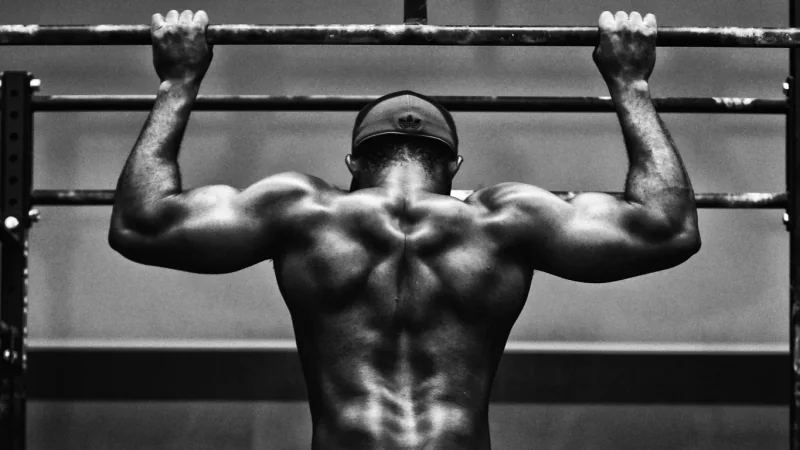
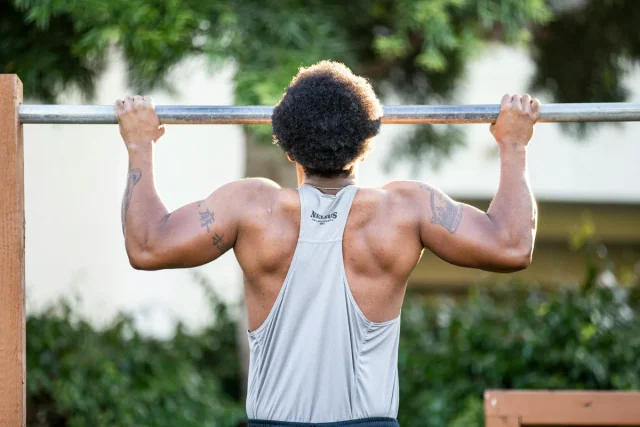
Pulling. This is the biggest practical weakness of literally equipment-free training. For pressing and legs, the floor and gravity are enough. For back and biceps you usually need something to pull on: a pull-up bar, rings, a very stable table, a band or another safe anchor.
Which is why “without weights” is considerably easier than “without any equipment at all”.
How it went for me at home
I also started at home with a lot of bodyweight work. The progression logic works well, because you do not need a complete home gym straight away.
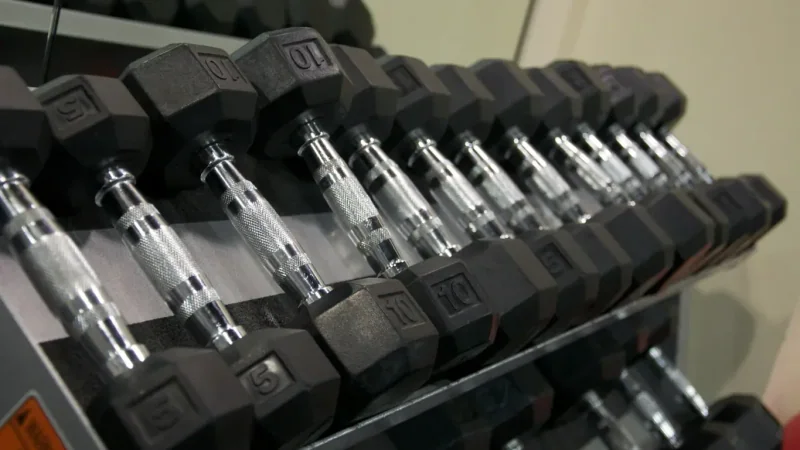
For me the wish for weights still came back relatively quickly. First a few dumbbells, later a barbell, plates, a bench and a rack — all in very little space.
The advantage was not that bodyweight suddenly “stopped working”. Weights simply make progression finer to dose. “This variation is still too easy, but the next one is too hard” turns back into: 2.5 kg more.
Calisthenics can be a complete training system. A home gym can be one too. For many people, the most sensible solution is somewhere in between.
What to buy first
If you want to build up gradually from an almost equipment-free setup:
| Order | What | Why |
|---|---|---|
| 1 | Pull-up bar or rings | Opens up genuine vertical and horizontal pulling progressions. |
| 2 | Resistance band | Cheap for assistance, isolation and assisted pull-ups. |
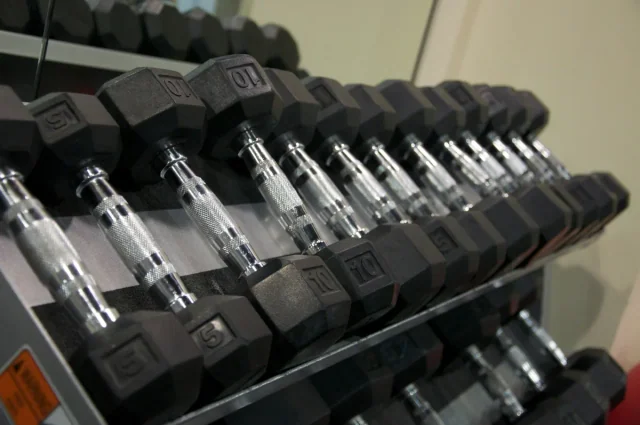
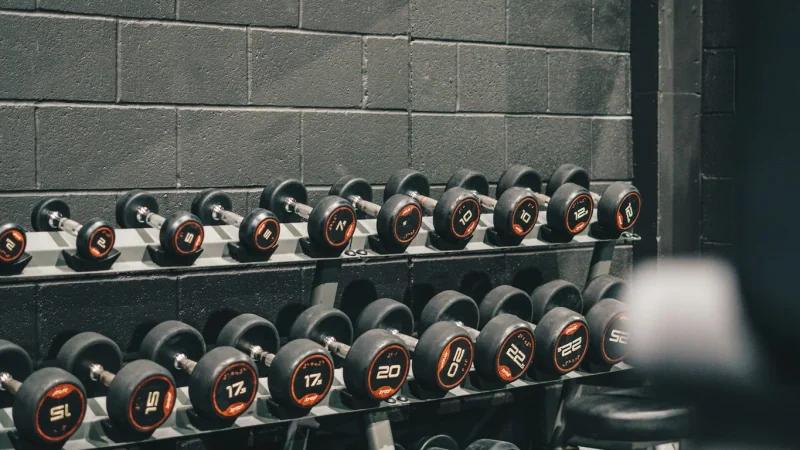
| 3 | Adjustable dumbbells | Make progression on legs and isolation work finely dosable. |
| 4 | Bench | Extends dumbbell training with incline work, rows, hip thrusts and more. |
| 5 | Barbell + rack | Particularly worthwhile once heavy squats, bench press and maximal strength matter. |
The biggest value-for-money jump usually sits in the first two items. Dumbbells get interesting as soon as you deliberately want more muscle growth, or leg progression with bodyweight starts getting annoying.
The Dumbbell Foundation plan is built for exactly this transition: full-body training with dumbbells and a stable bench.
Muscle growth or general fitness?
Your goal decides how long a very minimalist setup will do.
General fitness and health: For a very long time. Squat variations, push-ups, pulling exercises, hinges, core work and some cardio cover a lot.
Muscle growth: Also entirely possible, as long as every target muscle can be loaded sufficiently and progressed. In practice, legs and targeted isolation work eventually get more awkward.
Maximal strength in barbell lifts: Here specificity applies. Anyone wanting a high 1RM in the squat, bench press or deadlift has to train those movements with heavy external loads.
So the limit of bodyweight is not “no muscle grows past this point”.
The limit is more: at what point does the next progression become unnecessarily complicated?
Without weight you have to write it down
In the gym, progress is easy to see: 80 kg becomes 82.5 kg.
With bodyweight the progression looks less conspicuous:
- same exercise, one more rep
- feet a bit higher
- a harder progression stage
- a longer clean hold
Without a record, that progress quickly disappears from memory.
So in hitPR, bodyweight exercises can be represented as their own exercise type. Reps or duration can be tracked directly, and your last performance stays visible. For exercises with added weight there are corresponding variants with a weight column.
That is not a special problem for apps. A notebook works just as well.
Progression needs a reminder of what actually happened last week.
Conclusion
Strength training without weights works — but not because you do the same push-ups forever.
The most important progression lever is the exercise variation. Reps serve as fine tuning, leverage and range of motion can create intermediate stages, and tempo can make a variation temporarily more demanding.
The limitation is practical, not biological: some muscles and movements scale worse without additional equipment. For pulling in particular, a stable place to pull from is almost always the first sensible purchase.
If you are right at the start, getting into strength training is the better first read. And if you have a pull-up bar in a doorway but no time for full sessions: greasing the groove is made for that.
Sources
- Kikuchi N, Nakazato K (2017). Low-load bench press and push-up induce similar muscle hypertrophy and strength gain. Journal of Exercise Science & Fitness, 15(1):37–42.
- Schoenfeld BJ, Grgic J, Ogborn D, Krieger JW (2017). Strength and Hypertrophy Adaptations Between Low- vs. High-Load Resistance Training: A Systematic Review and Meta-analysis. Journal of Strength and Conditioning Research, 31(12):3508–3523.
- Lopez P, Radaelli R, Taaffe DR et al. (2021). Resistance Training Load Effects on Muscle Hypertrophy and Strength Gain: Systematic Review and Network Meta-analysis. Medicine & Science in Sports & Exercise, 53(6):1206–1216.
- Ebben WP, Wurm B, VanderZanden TL et al. (2011). Kinetic Analysis of Several Variations of Push-Ups. Journal of Strength and Conditioning Research, 25(10):2891–2894.
- Wurm B, VanderZanden T, Spadavecchia M, Durocher J, Bickham C, Petushek E, Ebben W (2010). Kinetic Analysis of Several Variations of Push-Ups. ISBS Conference Proceedings Archive, 28th International Conference on Biomechanics in Sports.
- Currier BS, D’Souza AC, Singh MAF et al. (2026). Resistance Training Prescription for Muscle Function, Hypertrophy, and Physical Performance in Healthy Adults: An Overview of Reviews. Medicine & Science in Sports & Exercise, 58(4):851–872.
- r/bodyweightfitness. Recommended Routine. Community wiki
Frequently Asked Questions
Can you build muscle with bodyweight?
How does progressive overload work without weights?
What is the minimum you need for strength training at home?
Are push-ups enough instead of bench press?
When are dumbbells worth it?
Plans in this article

Related Articles
Coming soon
Coming soon for Android and iOS. Be there for the launch.