Blog
Pilates vs. Strength Training: Which Fits Your Goals?
Contents
When choosing between Pilates and strength training, I recommend training with free weights or machines as your foundation for targeted muscle growth and greater strength. Pilates is a good fit if you want to improve core endurance, become more mobile and practise controlled movements. Combining them makes sense if both sets of goals matter to you.
Both forms of training make your muscles work against resistance. The main difference is how you train: a strength training plan can target individual muscles and measurable increases in load. Pilates combines strength exercises with mobility, breathing and control of your body position.
What can Pilates help you improve?
More core endurance: Pilates can help you hold demanding positions for longer. In a side plank, for example, the muscles along the side of your torso work to keep your pelvis raised. If you can hold that position for longer with the same form, your muscular endurance in that task has improved. That is useful progress even if lifting a heavier weight is not your goal.
Better movement control: In many exercises, you move your arms or legs while controlling the position of your torso. You practise allowing movement where you want it while keeping other parts of your body stable. Progress means performing the movement more precisely, with fewer unwanted movements elsewhere.
Greater mobility: A Pilates program can improve your range of motion. If you rarely make time for mobility exercises, a class gives them a regular place in your week. Which movements improve depends on the joints and positions you practise.
The practical benefit is having all of this in one session. You do not need to put together separate exercises for core work, mobility and movement control each time. If you enjoy guided sessions, Pilates can fit well into your weekly routine.
Why do weights make it easier to target muscle growth?
To grow, a muscle needs a sufficiently challenging workload, repeated training and recovery. As your performance improves, the task needs to become more demanding too. Weights make this easy to plan: you choose a suitable exercise and adjust the load in small increments.
Example: When doing rows, you initially manage eight reps with good form using 20 kg, then later ten. You have done more work with the same weight. You can then increase the weight a little and build up the reps again. This approach, called double progression, works for many exercises; the numbers are an example, not a recommendation for your starting weight.
You can also direct the work towards particular muscles. If you want to build your glutes, choose hip and leg exercises that you can load appropriately. Add pulling exercises for your back and suitable pressing exercises for your chest and shoulders. This gives each muscle group you want to develop a place in the plan.
Pilates can also stimulate muscle growth; MRI measurements have shown this in the abdominal muscles. For planning purposes, though, each muscle group matters individually. A demanding block of abdominal work tells you little about how much work your chest, back or legs are getting. Adding strength exercises lets you address these gaps.
My recommendation: If you want visible muscle growth, use a strength training plan with exercises you repeat regularly and progress you can track. Free weights and machines are both suitable; choose exercises you can perform with control and progress over time. The hypertrophy training guide explains how to balance load and training volume.
Does Pilates count as strength training, and what does the Reformer change?
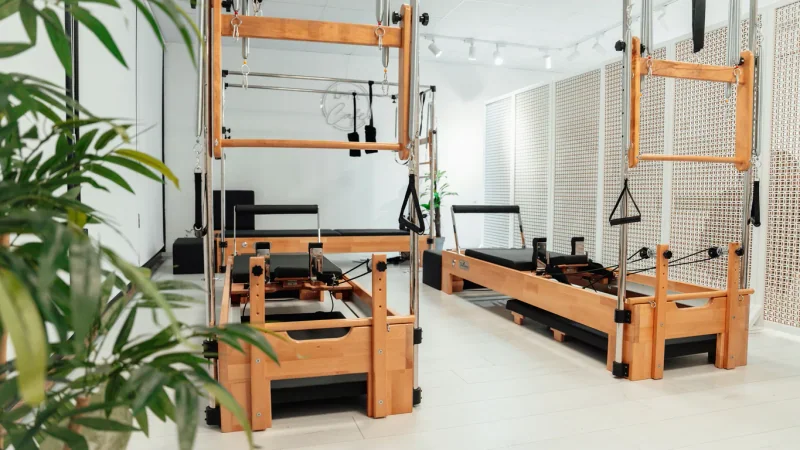
Yes, many Pilates exercises are strength exercises. Your bodyweight alone can create a demanding load, for example when you support your body or hold a straight leg up against gravity. A Reformer adds a moving carriage and springs.
| Type of training | What creates the resistance? | How can you progress? |
|---|---|---|
| Mat Pilates | Bodyweight and the leverage created by your position | Use a more challenging variation or a longer lever, perform more controlled reps or hold the position for longer |
| Reformer Pilates | Bodyweight, springs and control of the carriage | Adjust the exercise and spring settings appropriately, and perform more work with control |
| Training with free weights or machines | An added load you can select | Increase the weight, reps and, when needed, training volume |
On the Reformer, ask about the details: What is meant to become harder in this exercise? A spring also changes how stable the carriage is. In some exercises, a lighter spring therefore requires more effort to hold your position. Ask your instructor to show you which setting puts more load on the intended muscles and which mainly makes movement control more challenging.
In practice, try to record which variation you perform and which settings you use. You can then see whether you are getting stronger, lasting longer or controlling the movement better. This distinction also helps when choosing a class: to gain strength, you need tasks that become more challenging as you improve. The principle behind this is progressive overload.
Do you need Pilates to stay flexible?
Both Pilates and strength training can improve mobility. Controlled strength training through a large range of motion that you can manage comfortably lets you practise moving into and out of those positions under load. This develops mobility and strength in the same movement.
Practical recommendation: Start by looking at your current training. If your strength training plan covers the movements you need, you do not have to add a Pilates session solely for mobility. If you want to practise other positions or enjoy guided movement sequences, Pilates is an option.
A specific mobility goal helps you choose. “I want to raise my arms further overhead with control” is easier to assess than “I want to be more flexible overall”. Check whether your class or exercise trains that particular movement. The article on mobility through strength training explains more.
What helps with toning up and losing weight?
If by “toning up” you mean having more visible muscle definition, building muscle is a suitable goal. If you also want to reduce body fat, that needs its own planning: over time, your energy intake must be lower than your energy expenditure. Diet, training and everyday physical activity all contribute.
Strength training has a useful role during weight loss: you keep challenging your muscles while taking in less energy. This helps preserve as much strength and muscle as possible. That makes the training worthwhile even if it does not make the number on the scale drop faster.
For your training week: Keep your strength exercises and choose extra physical activity that you can do regularly. That might be Pilates if you enjoy the classes, or a walk if it is easier to fit in. The article on strength training, steps and fat loss explains how strength training and everyday activity work together.
The promise of “long, lean muscles” is not a useful training goal. Exercise can change muscle size, strength and your ability to move; it cannot guarantee a particular body shape. Choose a goal that lets you recognise your own progress, such as stronger legs, more shoulder mobility or less body fat if that is what you want.
Which type of training suits your goal?
The table below summarises the practical recommendations. Choose your main goal first, then add the other type of training where it offers you an extra benefit.
| Your goal | Recommendation | How to recognise progress |
|---|---|---|
| Build specific muscles | Make strength training your foundation | Long-term development of the muscles you want to build; better performance in the relevant exercises |
| Lift more weight | Train the relevant strength exercises | More weight with comparable form |
| Hold stable positions for longer and control movement sequences | Pilates with suitable exercises | Longer holds or more challenging variations with the same control |
| Improve mobility | Pilates or strength exercises for the range of motion you want to improve | A greater range of motion under control |
| Preserve strength and muscle while losing weight | Keep strength training, and plan your diet and everyday activity accordingly | Look at body weight and strength performance together over several weeks |
If you only have two training sessions per week and a clear muscle-building goal, I would initially use both for strength training. If Pilates is your preferred form of exercise and your main interests are core work and movement sequences, you can start there. Add another session when you want to pursue an additional goal and have enough time to train and recover.
How to combine Pilates and strength training
A starting example with muscle growth as the priority: Two full body strength sessions and one Pilates session give both forms of training a regular place in your week. The schedule below is a practical recommendation; adjust the duration and workload to your training level.
| Day | Training | Focus |
|---|---|---|
| Monday | Full body strength training, around 45 minutes | Leg, pulling and pressing exercises; record weights and reps |
| Wednesday | Pilates, around 50 minutes | Core endurance, controlled movement sequences and mobility, depending on the class content |
| Friday | Full body strength training, around 45 minutes | Continue your strength training plan and compare performance with the previous session |
Time needed in this example: 2 × 45 + 50 gives you 140 minutes of training per week, plus travel and changing time. This simple calculation for the sample schedule helps you check whether the week is realistic for you. You can find a structure for the strength sessions in the strength training guide for beginners.
When planning, account for how demanding your Pilates class is. After a lot of leg or core work, you may still be fatigued by your next strength session. If your performance repeatedly drops, leave more time between sessions or start by reducing the extra training volume. If you recover well and make progress, the combination suits the amount of training you can currently handle.
Conclusion
For targeted muscle growth and measurable strength gains, I recommend training with free weights or machines as your foundation. Pilates offers a way to work on core endurance, mobility and controlled movements together.
Decide on your main goal, reserve regular training times for it and track the relevant progress. This also helps you judge whether combining the two offers more than another session of the same type of training.
Sources
- Currier BS et al. (2026). American College of Sports Medicine Position Stand. Resistance Training Prescription for Muscle Function, Hypertrophy, and Physical Performance in Healthy Adults: An Overview of Reviews. Medicine & Science in Sports & Exercise. Basis for the guidance on strength training and progression. One author discloses a previous consultancy role with equipment manufacturer Tonal.
- Kim HJ et al. (2024). Effect of Reformer Spring Resistance Modifications on Core Muscle Activity During Basic Core Muscle Exercises. Healthcare, 12(23):2447. Acute measurement of muscle activity.
- Dorado C et al. (2012). Marked Effects of Pilates on the Abdominal Muscles: A Longitudinal Magnetic Resonance Imaging Study. Medicine & Science in Sports & Exercise, 44(8):1589–1594.
- Dorado C et al. (2020). Hypertrophy of Lumbopelvic Muscles in Inactive Women: A 36-Week Pilates Study. Sports Health, 12(6):547–551. Further muscle analysis in the same small group of participants.
- Gökalp Ö, Kirmizigil B (2025). Effects of Reformer Pilates on Body Composition, Strength, and Psychosomatic Factors in Overweight and Obese Women: A Randomized Controlled Trial. Scientific Reports, 15:23602.
- Bajčetić Č et al. (2026). Effects of Pilates Programs on Body Composition, Flexibility, Muscular Strength, Balance, Functional Performance and Respiratory Function in Adult Women: A Systematic Review and Meta-Analysis. Sports, 14(9):407. Published on 15 September 2026.
- Alizadeh S et al. (2023). Resistance Training Induces Improvements in Range of Motion: A Systematic Review and Meta-Analysis. Sports Medicine, 53:707–722.
- Binmahfoz A et al. (2025). Effect of Resistance Exercise on Body Composition, Muscle Strength and Cardiometabolic Health During Dietary Weight Loss in People Living with Overweight or Obesity: A Systematic Review and Meta-Analysis. BMJ Open Sport & Exercise Medicine, 11:e002363. Basis for the guidance on strength training during a diet.
- National Institute of Diabetes and Digestive and Kidney Diseases. Eating & Physical Activity to Lose or Maintain Weight. Basics of diet, physical activity and weight change.
Frequently Asked Questions
Does Pilates count as strength training?
Can you build muscle with Pilates?
Can Reformer Pilates replace strength training with weights?
How can I combine Pilates and strength training?
Is Pilates or strength training better for weight loss?
Related Articles
Coming soon
Coming soon for Android and iOS. Be there for the launch.